1. Introduction
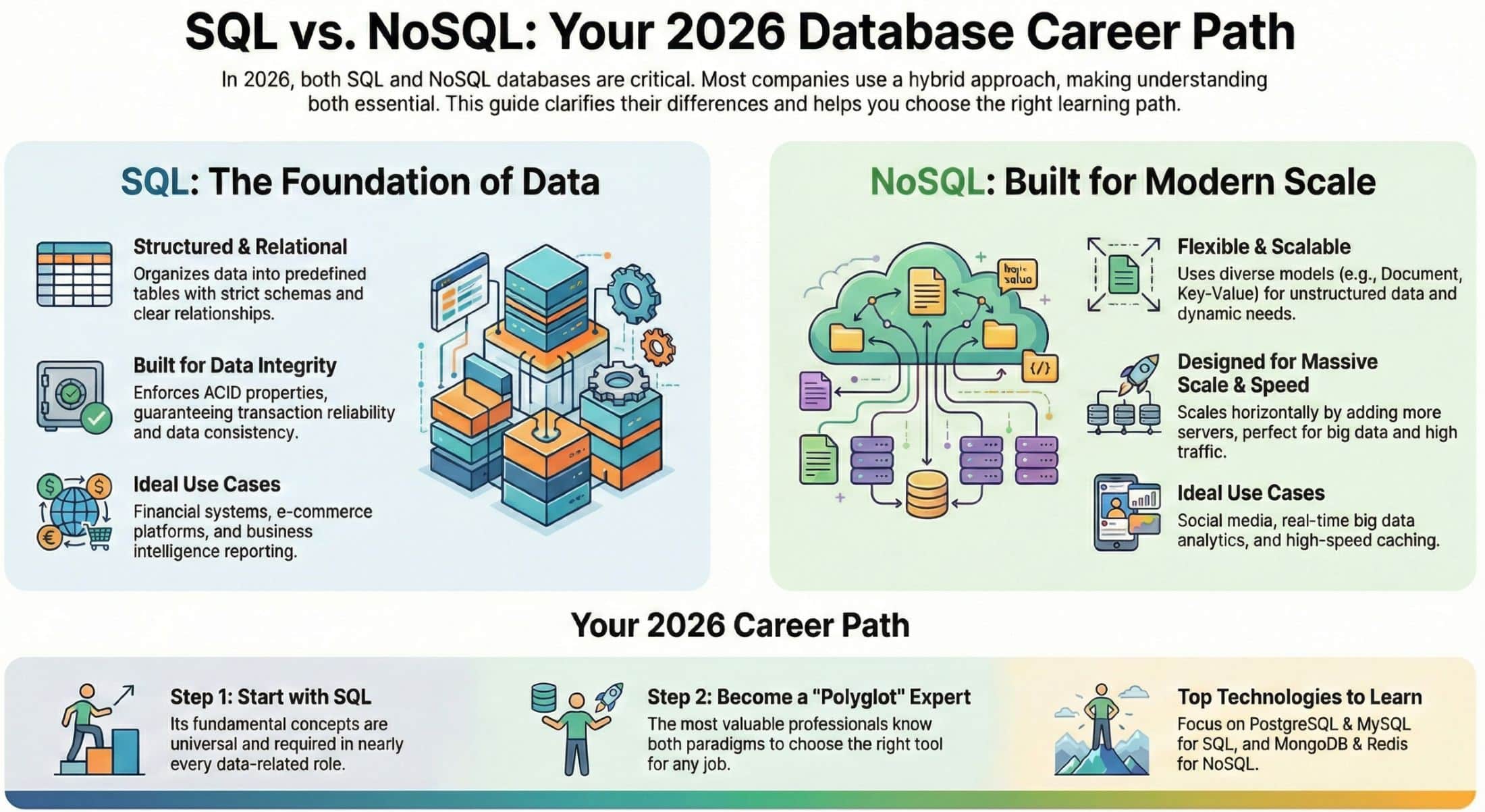
In the rapidly evolving landscape of data management and software development, choosing the right database (SQL vs NoSQL) technology is more critical than ever. As we navigate through 2026, the debate between SQL (Structured Query Language) and NoSQL (Not Only SQL) databases continues to shape career decisions for aspiring developers, data engineers, and database administrators.

The database market has matured significantly, with both SQL and NoSQL technologies offering robust solutions for different use cases. According to recent industry surveys, over 65% of organizations now use a hybrid approach, employing both SQL and NoSQL databases within their technology stack. This makes understanding both paradigms essential for modern developers.
This comprehensive guide will help you understand the fundamental differences between SQL and NoSQL databases, their respective strengths and weaknesses, and most importantly, which one you should prioritize learning based on your career goals and the current industry landscape.
2. Understanding SQL Databases
SQL databases, also known as relational databases, have been the backbone of enterprise data management for over four decades. These databases organize data into structured tables with predefined schemas, where data is stored in rows and columns with clear relationships between different tables.
Core Characteristics of SQL Databases
SQL databases are built on the foundation of relational database management systems (RDBMS). They enforce ACID properties (Atomicity, Consistency, Isolation, Durability), which ensure data integrity and reliability even in the event of system failures or concurrent transactions.
The structured nature of SQL databases means that data must conform to a predefined schema. This schema defines the tables, columns, data types, and relationships before any data is inserted. While this can seem restrictive, it provides powerful advantages in terms of data integrity, query optimization, and maintaining complex relationships between different data entities.
SQL databases use Structured Query Language (SQL) as a standardized way to interact with the data. This declarative language allows developers to specify what data they want without worrying about how the database retrieves it. SQL’s consistency across different database systems means that skills learned on one platform largely transfer to others.
Popular SQL Database Examples
The most widely used SQL databases in 2026 include PostgreSQL, MySQL, Microsoft SQL Server, Oracle Database, and SQLite. PostgreSQL has gained significant traction in recent years due to its advanced features, excellent performance, and open-source nature. MySQL remains popular for web applications and is the default choice for many content management systems. Microsoft SQL Server dominates in enterprise Windows environments, while Oracle Database continues to serve large-scale enterprise applications requiring robust features and high availability.
3. Understanding NoSQL Databases
NoSQL databases emerged in the late 2000s as a response to the limitations of traditional relational databases when dealing with massive scale, unstructured data, and rapidly changing requirements. The term NoSQL stands for “Not Only SQL,” emphasizing that these databases don’t necessarily replace SQL databases but rather complement them for specific use cases.
Types of NoSQL Databases
NoSQL is not a single technology but rather a category encompassing several different database models, each optimized for specific scenarios:
Document Databases store data in flexible, JSON-like documents. Each document can have its own structure, making them ideal for applications where data schemas evolve frequently. MongoDB and CouchDB are leading examples of document databases, widely used in content management systems, e-commerce platforms, and mobile applications.
Key-Value Stores are the simplest NoSQL databases, storing data as a collection of key-value pairs. They excel at high-speed read and write operations and are commonly used for caching, session management, and real-time data processing. Redis and Amazon DynamoDB are prominent key-value stores used by millions of applications worldwide.
Column-Family Stores organize data into columns rather than rows, making them extremely efficient for analytical queries that need to process large datasets. Apache Cassandra and HBase are examples of column-family databases used by companies like Netflix and Facebook for handling massive amounts of time-series data and user activity logs.
Graph Databases are designed to handle highly connected data, representing information as nodes and relationships. They excel at queries involving complex relationships and are ideal for social networks, recommendation engines, and fraud detection systems. Neo4j and Amazon Neptune lead this category.
Core Principles of NoSQL
NoSQL databases prioritize horizontal scalability, meaning they can handle growth by adding more servers rather than upgrading existing hardware. They typically follow the BASE model (Basically Available, Soft state, Eventually consistent) rather than ACID, trading some consistency guarantees for better availability and partition tolerance. This makes them particularly suitable for distributed systems and cloud-native applications.
4. Key Differences Between SQL and NoSQL
Understanding the fundamental differences between SQL and NoSQL databases is crucial for making informed decisions about which technology to learn and when to use each one.
| Aspect | SQL Databases | NoSQL Databases |
|---|---|---|
| Data Structure | Structured tables with fixed schemas and predefined columns | Flexible schemas allowing dynamic data structures |
| Scalability | Vertical scaling (adding more power to existing servers) | Horizontal scaling (adding more servers to the cluster) |
| Data Integrity | Strong ACID compliance ensures data consistency | BASE model prioritizes availability over immediate consistency |
| Query Language | Standardized SQL language across platforms | Database-specific query APIs and languages |
| Relationships | Built-in support for complex joins and relationships | Limited or no native join support; relationships handled at application level |
| Best For | Complex queries, transactions, structured data | Large-scale data, rapid development, unstructured data |
| Schema Changes | Requires careful planning and migration strategies | Easy to adapt to changing requirements |
| Performance | Excellent for complex queries and reporting | Superior for simple read/write operations at scale |
5. SQL: Pros and Cons
Advantages of SQL Databases
Data Integrity and Consistency: ACID properties ensure that your data remains accurate and consistent even during system failures or concurrent operations.
Mature Ecosystem: Decades of development have resulted in robust tools, extensive documentation, and a large community of experienced professionals.
Powerful Query Capabilities: SQL’s declarative syntax enables complex queries, aggregations, and joins with relatively simple code.
Standardization: SQL is standardized across different database systems, making skills highly transferable.
Strong Security: Well-established security models with granular access controls and encryption capabilities.
Excellent for Complex Relationships: Foreign keys and joins make it natural to represent and query related data.
Limitations of SQL Databases
Rigid Schema: Changes to database structure require careful planning and can be difficult in production environments.
Vertical Scaling Limits: There’s a practical limit to how powerful a single server can become, making very large-scale applications challenging.
Impedance Mismatch: Object-oriented programming languages don’t naturally align with relational data models, requiring additional mapping layers.
Performance at Scale: While excellent for many scenarios, SQL databases can struggle with extremely high write volumes or massive datasets.
Less Flexible for Rapid Development: Requiring schema definition upfront can slow down agile development processes.
6. NoSQL: Pros and Cons
Advantages of NoSQL Databases
Horizontal Scalability: Easily scale out by adding more servers, making it ideal for handling massive amounts of data and traffic.
Schema Flexibility: Adapt quickly to changing requirements without database migrations or downtime.
High Performance for Simple Operations: Optimized for fast read and write operations, especially for key-based lookups.
Cloud-Native Design: Many NoSQL databases are built from the ground up for distributed, cloud-based environments.
Developer-Friendly: JSON-like data structures in document databases align naturally with modern programming languages.
Specialized Solutions: Different NoSQL types are optimized for specific use cases like real-time analytics, caching, or graph traversal.
Limitations of NoSQL Databases
Eventual Consistency: Many NoSQL databases sacrifice immediate consistency, which can complicate application logic.
Limited Query Capabilities: Complex queries and aggregations can be more difficult or impossible compared to SQL.
No Standardization: Each NoSQL database has its own query language and concepts, reducing skill transferability.
Less Mature Tooling: While improving, the ecosystem of management and monitoring tools is less developed than for SQL databases.
Data Duplication: The lack of joins often means denormalizing data, leading to redundancy and potential inconsistencies.
Learning Curve: Understanding distributed systems concepts and eventual consistency requires additional knowledge.
7. When to Use SQL
SQL databases remain the optimal choice for a wide range of applications and scenarios. Understanding when to use SQL will help you make better architectural decisions and choose the right learning path.
Ideal Use Cases for SQL Databases
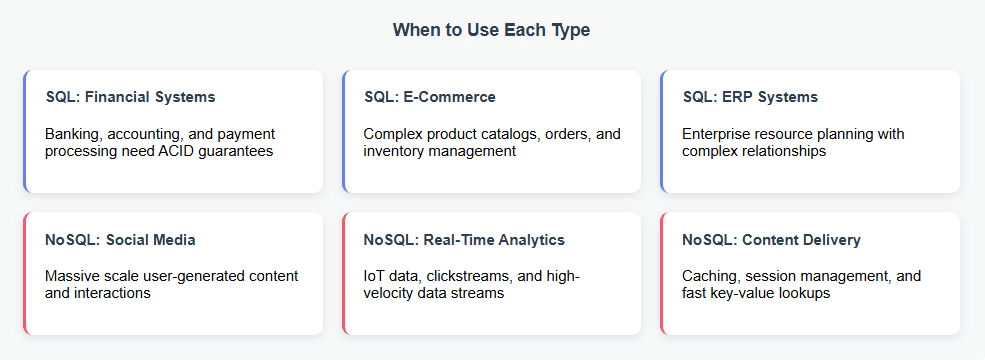
Financial Systems and Banking: When data integrity and ACID compliance are non-negotiable, SQL databases are the clear choice. Banking systems, payment processing, and financial reporting all require the strong consistency guarantees that SQL databases provide. A single inconsistency in account balances could have serious consequences.
Enterprise Resource Planning (ERP): Systems managing inventory, human resources, customer relationships, and supply chain operations typically involve complex relationships between entities. SQL’s ability to handle joins and maintain referential integrity makes it ideal for these applications.
E-commerce Platforms: Online stores need to manage products, customers, orders, inventory, and payments with strict consistency. The transactional nature of e-commerce, where orders must be processed reliably, makes SQL databases a natural fit.
Content Management Systems: Traditional CMS platforms benefit from SQL’s structured approach to organizing content, categories, users, and permissions. The ability to perform complex queries for searching and filtering content is invaluable.
Business Intelligence and Reporting: When you need to perform complex analytical queries across multiple related tables, SQL’s JOIN operations and aggregation functions are unmatched. Data warehouses and reporting systems heavily rely on SQL databases.
Applications Requiring Complex Queries: If your application needs to perform sophisticated filtering, sorting, grouping, and joining operations, SQL databases excel at query optimization and execution planning.
8. When to Use NoSQL
NoSQL databases shine in scenarios where flexibility, scalability, and performance at massive scale are priorities. Recognizing these use cases will help you understand where NoSQL provides distinct advantages.
Ideal Use Cases for NoSQL Databases
Social Media and User-Generated Content: Platforms like Facebook, Twitter, and Instagram handle billions of posts, comments, and interactions daily. NoSQL databases can scale horizontally to accommodate this growth while maintaining high performance for simple read and write operations.
Real-Time Big Data Analytics: Applications processing large volumes of streaming data, such as IoT sensor data, clickstream analytics, or log aggregation, benefit from NoSQL’s ability to handle high write throughput and scale linearly.
Content Delivery and Caching: Key-value stores like Redis excel at caching frequently accessed data, session management, and real-time leaderboards. Their sub-millisecond latency makes them perfect for performance-critical applications.
Mobile and Gaming Applications: Games and mobile apps often need to iterate quickly, with data models that evolve based on user feedback. NoSQL’s flexible schema allows developers to add new features without database migrations.
Catalog and Product Information: E-commerce sites with diverse product catalogs where different products have vastly different attributes benefit from document databases’ flexible schema.
Recommendation Engines and Social Networks: Graph databases excel at traversing relationships and finding patterns in highly connected data. They’re ideal for friend suggestions, product recommendations, and fraud detection.
Time-Series Data: Column-family databases are optimized for storing and querying time-series data such as stock prices, weather measurements, or application metrics.
9. Popular Database Systems in 2026
The database landscape in 2026 features both established leaders and emerging technologies. Understanding the market leaders will help you prioritize which specific systems to learn.
Top SQL Databases
PostgreSQL has emerged as the most popular open-source relational database, known for its advanced features, excellent documentation, and strong community. It supports both SQL and JSON queries, making it versatile for modern applications. PostgreSQL’s reliability and extensibility have made it the default choice for many startups and enterprises.
MySQL remains widely used, especially in web hosting environments and legacy applications. Its simplicity and widespread support make it an excellent choice for learning SQL fundamentals. MySQL powers millions of websites and is the backbone of popular platforms like WordPress.
Microsoft SQL Server dominates in enterprise environments running on Windows infrastructure. Its tight integration with the Microsoft ecosystem and powerful business intelligence tools make it valuable for organizations invested in Microsoft technologies.
Top NoSQL Databases
MongoDB continues to lead the document database category with its developer-friendly approach and comprehensive ecosystem. It’s become the de facto standard for modern web applications requiring flexible data models. MongoDB’s query language and aggregation framework provide powerful capabilities while maintaining schema flexibility.
Redis remains the most popular key-value store and caching solution. Its speed, simplicity, and rich data structure support make it essential for building high-performance applications. Redis is used by virtually all major tech companies for caching and real-time operations.
Apache Cassandra powers applications requiring massive scale and high availability, such as Netflix’s viewing data and Apple’s services infrastructure. Its ability to handle petabytes of data across multiple data centers makes it invaluable for global applications.
Amazon DynamoDB has become the leading managed NoSQL database, offering seamless scaling and integration with AWS services. Its serverless model eliminates operational overhead, making it popular for cloud-native applications.
10. Which Should You Learn First?
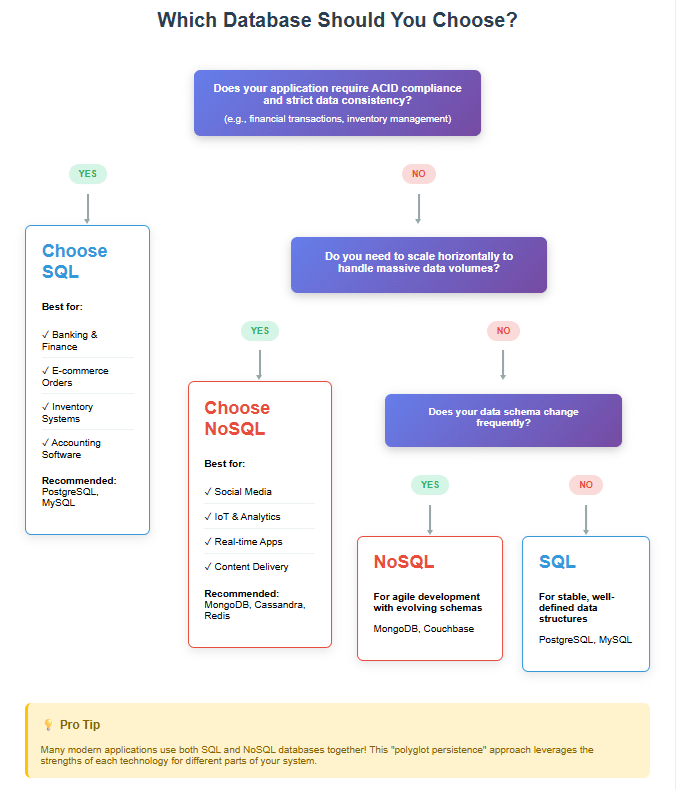
This is perhaps the most important question for your career development. The answer depends on several factors including your career goals, the industry you’re targeting, and current job market trends.
Start with SQL: The Foundation
For most developers and data professionals, learning SQL first is the recommended approach. Here’s why SQL should typically be your starting point:
Universal Relevance: SQL skills are required in almost every software development and data analysis role. Even organizations that primarily use NoSQL databases often maintain SQL databases for critical operations. Job postings requiring SQL knowledge outnumber those requiring specific NoSQL skills by a significant margin.
Transferable Concepts: Learning SQL teaches you fundamental database concepts including data modeling, normalization, indexing, query optimization, and transaction management. These concepts remain valuable even when working with NoSQL databases.
Immediate Productivity: SQL’s standardized syntax means you can quickly become productive across different database systems. The skills you learn with PostgreSQL translate directly to MySQL, SQL Server, and other SQL databases.
Better Decision Making: Understanding SQL’s strengths and limitations helps you make informed decisions about when NoSQL might be a better choice. Many developers who learn NoSQL first struggle to recognize scenarios where SQL would be more appropriate.
When to Prioritize NoSQL
There are specific situations where learning NoSQL first or in parallel with SQL makes sense:
Specific Job Requirements: If you’re targeting a role that explicitly requires MongoDB, Redis, or another NoSQL technology, prioritizing that technology is reasonable. However, still plan to learn SQL basics relatively soon.
Modern Web Development Focus: Developers focused on building modern web applications with the MEAN or MERN stack (MongoDB, Express, Angular/React, Node.js) might choose to learn MongoDB early in their journey alongside JavaScript.
Real-Time Systems: If you’re specifically interested in building real-time applications, learning Redis or other key-value stores might be prioritized alongside understanding caching strategies.
Recommended Learning Sequence
For most learners, the following sequence provides a balanced foundation:
Phase 1 (Months 1-3): Master SQL fundamentals including SELECT statements, joins, aggregations, subqueries, and basic database design. Use PostgreSQL or MySQL for hands-on practice. Complete projects that involve creating databases for real-world scenarios like a blog system or inventory management.
Phase 2 (Months 4-5): Deepen SQL knowledge with advanced topics including indexing strategies, query optimization, transactions, stored procedures, and database administration basics.
Phase 3 (Months 6-8): Introduce NoSQL concepts and learn a document database like MongoDB. Build projects that demonstrate understanding of when to use NoSQL versus SQL. Experiment with different data modeling approaches.
Phase 4 (Months 9-12): Explore specialized NoSQL databases based on your interests. Learn Redis for caching, or Neo4j for graph data, or Cassandra for distributed systems. Build hybrid applications using both SQL and NoSQL databases.
11. Career Prospects and Salary Insights
Understanding the career implications of your database skills can help guide your learning priorities and specialization choices.
SQL Career Opportunities
SQL skills open doors to a wide range of roles including Database Administrator, Data Analyst, Business Intelligence Developer, Backend Developer, and Data Engineer. According to 2026 industry reports, the average salary for professionals with strong SQL skills ranges from $75,000 for entry-level positions to over $150,000 for senior database architects and specialized consultants.
SQL skills are particularly valuable in finance, healthcare, government, and traditional enterprises where data integrity and complex reporting are critical. The demand for SQL professionals remains steady, with job postings consistently showing SQL as one of the most requested technical skills.
NoSQL Career Opportunities
NoSQL expertise is increasingly valued in roles such as NoSQL Database Administrator, Cloud Architect, DevOps Engineer, Full-Stack Developer, and Big Data Engineer. Professionals specializing in NoSQL technologies often command premium salaries, particularly when combined with cloud platform expertise.
Companies building modern, scalable applications especially tech startups, SaaS providers, and digital-first businesses actively seek developers with NoSQL experience. MongoDB developers, for instance, can expect competitive salaries ranging from $80,000 to $160,000 depending on experience and location.
The Polyglot Persistence Advantage
The most valuable professionals in 2026 are those who understand both SQL and NoSQL paradigms and can make informed decisions about which technology to use for specific scenarios. This “polyglot persistence” approach positions you as a strategic thinker rather than just a technical implementer.
Senior architects and technical leads who can design systems using multiple database technologies command salaries in the $140,000 to $200,000 range, with top professionals in major tech hubs earning significantly more.
12. Conclusion
The SQL versus NoSQL debate isn’t about choosing a winner but rather understanding that both technologies serve important and often complementary roles in modern software architecture. As we navigate through 2026, the most successful data professionals are those who understand both paradigms and can apply each appropriately.
For aspiring database professionals and developers, the clear recommendation is to start with SQL. Build a solid foundation in relational database concepts, master the SQL language, and understand when traditional databases excel. This foundation will serve you throughout your career regardless of which technologies emerge in the future.
Once you’re comfortable with SQL, expand into NoSQL technologies based on your specific interests and career direction. Learn MongoDB for flexible document storage, Redis for caching and real-time features, or Cassandra for distributed systems. Each adds valuable tools to your skillset.
Remember that databases are ultimately tools for solving problems. The best database professionals focus not on mastering a single technology but on understanding the problem domain deeply enough to choose the right tool for each situation. Whether that tool is SQL, NoSQL, or a combination of both depends on the specific requirements of reliability, scalability, consistency, and performance.
The future belongs to developers and data professionals who embrace continuous learning and remain flexible in their approach to data management. Start your journey with SQL, expand into NoSQL when appropriate, and most importantly, build real projects that help you understand not just how these technologies work, but when and why to use them.